• Home
    • About the Yoga
    • About Jessica
    • About the Ministry
    • Gratitude
    • Teaching
    • Testimonials
    • Portfolio
    • Reproductive Chaplaincy
    • Spiritual Direction
    • Ministry
  • Contact
  • Blog
Menu

jessica young chang

Street Address
City, State, Zip
Phone Number

Your Custom Text Here

jessica young chang

  • Home
  • About
    • About the Yoga
    • About Jessica
    • About the Ministry
    • Gratitude
  • Offerings
    • Teaching
    • Testimonials
    • Portfolio
  • Reproductive Chaplaincy
    • Reproductive Chaplaincy
    • Spiritual Direction
    • Ministry
  • Contact
  • Blog
photo 2.JPG

Blog

Blog

do you wanna know what Jess has to say?

Woke Yoga

November 11, 2016 Jessica Young
Because sometimes I need my calming, nature images to have a little more backbone.  Because I am out of time. I can no longer afford for yoga to only be the feel-good, self-aggrandizing love fest anymore. I need yoga to wake the fuck up. And yo…

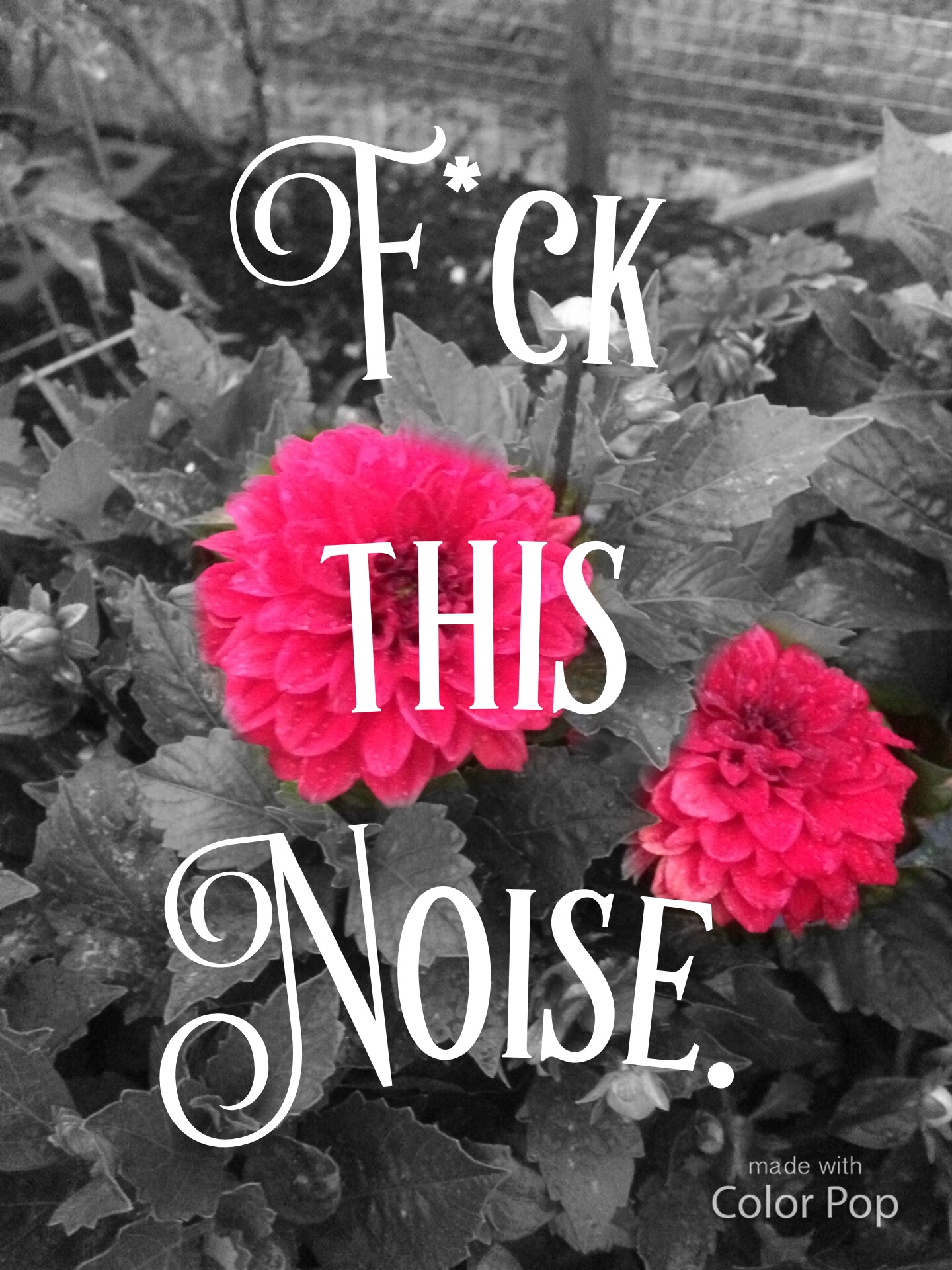
Because sometimes I need my calming, nature images to have a little more backbone.  

Because I am out of time. I can no longer afford for yoga to only be the feel-good, self-aggrandizing love fest anymore. I need yoga to wake the fuck up. And you may not know it, but you need it too. 

On November 8, I went to work, I provided care, I taught a class, and I voted.

I spent that evening and most of November 9 weeping in rage and terror.

I am not gonna talk about why I feel traumatized and betrayed but not surprised. I am not gonna talk about what a painful reminder the 2016 election has been of what our country is, what fear, what hatred, what racism, lives vibrant and healthy in our nation. (because this is current and not just history, fuck history, time moves in a spiral, and history is repeating itself.) 

“I can’t believe what you say, because I see what you do.”
— James Baldwin

Instead, I wanna talk about how we as yogis respond.

Part of my training as a yoga teacher was more or less this: leave your politics at the door. Your work as a teacher is not about what you think or what you want. It begins and ends with your ability to facilitate safety, growth and healing for every student who walks into your shared learning space. 

It seems pretty sound advice. But I'm not sure it's possible.

My politics can't stay at the door. My politics come with me, in my skin, my eyes, my lips, my hair, my voice. I'd argue the same is true of every teacher in this country, whether we acknowledge it or not, whether we even know it or not. The fact of my body in the room, especially at the "front of the room" has political weight. This is a reality I have no control over. Being a black woman in the seat of the teacher has meaning. That meaning might change depending on who else is in the room with me, but it's not gonna go away, no matter what I wear, what voice I affect, what practice I teach. I'm not afraid of it, and I'm not going to pretend it isn't there. And now, if it's possible, being a black woman in the seat of the teacher has even more meaning, than it did last week. To leave politics at the door is an act of privilege, it's a privilege I don't share, and frankly, I don't think any of us can afford it.

Like many of us, I was all up in my screens during the aftermath of the election--what a strange phrase, "aftermath" like a natural disaster--and in my FB and Instagram feeds were posts from teachers I respect, some I know closely, some I've never met: photos of sunrises and fields of flowers and abstract watercolors: posts about how we're all gonna be okay, how the sun keeps coming up every day and there's a lesson in that for all of us, how the practice is about cultivating equanimity, work without detachment, even when times are tough.

All I could think was, don't fucking tell me it's gonna be okay, don't fucking talk to me about equanimity, don't fucking talk to me about detachment. I don't want to hear about peace and self-care. I fear for my life. I fear for the lives of my clients, and some of my students. Less Shiva on the mountain top, more Kali liberating motherfuckers by chopping off heads.

(I know, scholars, I know. I get that Kali liberates us from our ego, and her destructive force is what helps us not to identify with our bodies. I live in America, where to disengage from my body is to put it at risk of annihilation by a force that doesn't seek my liberation, that only seeks the annihilation of black bodies in America. So just, work with the metaphor.)

It's true, I'm in my feelings in a big way. No, that's not the right language: I feel terrorized by the nation I call home. This feeling is not new. It might lessen in the passing of time, but it will never leave: I'm a black woman in America. If you can't understand why the undercurrent of terror in my existence is real, you have more reading to do. 

I struggle with posts like these, wherein yoga/pranayama/samyama are identified as the tools of healing-as-detachment, because they feel somehow rooted in abandonment. They seem to say, yes, shit is bad, but don't feel that bad here, in the yoga space. Here, you should return to your practice of detachment and ignore all other input. That will be a healing practice for you. I do not believe denial is healing. It's dangerous.

Yoga is not a vacation. It can be restful, but it is not rest. Whatever your effort level, yoga is a constant practice of attention, reflection, and interrogation, and that takes effort. To sell yoga as a place where suddenly politics don't matter, where suddenly part of what you feel and struggle with isn't real anymore, is just dishonest.

If the manifestation of equanimity in your practice means you distance rather than engage with the world around you--if you don't look for ways to actively support the people of color in your life, the Trans* folk, the immigrants, the Muslims, the workers, the women--if it means, white yogis and yoginis, that you are not having difficult conversations with other white yogis and white friends and family about how you reach for those of us on the margins, how you show up for we who are even less safe now, then regardless of what you can do with your breath or your body, your practice is failing you. 

Let me say that again, simpler:

if your practice and its fruits do not motivate you to seek the rights of others in our world to be free, to breathe, to live and work with as much access, freedom, and safety as you have, then your practice is failing you. It is failing you, and failing your community. 

Fuck yes, it is a bold statement.

There's a beckoning tangent here about the history of the yogini as a person on the margin and how we gotta put ourselves where our yoga ancestors began, but instead of following it, I ask, why do we try to soothe so quickly and so certainly after collective trauma? Why do we need to keep telling ourselves and others to calm down, to take care, to take the good and the bad with equal detachment?  Why are we in such a hurry to move people out of their feelings?

I think some of us are afraid of the conflict inherent in politics. Conflict is not serene, it's not equanimous; it's unpredictable, dangerous, potentially damaging, like a power tool in the hands of a toddler. How do we achieve oneness with the Absolute if we've got our knickers in a twist and our blood pressure all hiked up about something? How can I listen for the whisper of the Divine if I'm shouting all the time? Knowing that I'm in conflict with a member of my community makes it harder for me to practice beside them, right? 

I understand. Most of us don't do conflict well enough not to be scared of it. But conflict can be real, powerful, AND deeply compassionate. We can fight for what is right, what is just and even merciful, without hardening our hearts to do so, and without hating or harming our neighbors. We have so many examples of how to do this. Jesus got mad. Jesus flipped tables and marched in streets. He also sat quietly, and he knew how to sacrifice for others. I learned recently that when Martin Luther King was here in Chicago marching with others for fair housing rights, a young white man on the street was spitting and cursing and throwing bottles at him and others. He walked up to this young man and said, "You are too smart and too good looking to be so full of hate." We hold them up as saints now, but they were just humans, like us. It's possible.

I also think it has to be said in our capitalist yoga society, that to publicly acknowledge, avow and affirm opinions that aren't popular with all people can cost you clients. Because politics breed conflict, and because people don't like conflict, if you bring to them rhetoric that challenges them, they won't stay. Or they won't come back. While we as yoga teachers say we want to help others manifest growth, healing and connection, we also want to feed our families and keep our kids in shoes. Right now we are stuck in (complicit in?) a system that grinds us into yoga-sparkle dust trying to do both of these things. And so we have to try not to sacrifice our morals and values in pursuit of earning a living and hope that throwing conscious crumbs before our students is enough, or we choose to sacrifice our values and live with the consequences of that dissonance. (Hint: chronic illness, consistent conflict in relationship, scorn, resentment, contempt and self-hatred are all symptoms of life with that dissonance.) Angela Jamison has written about this brilliantly, beautifully, here, and Mathew Remski's essay in this book makes me want to snatch up a few of my like-minded teachers and do some real radical shit. I can only say that for all the deep, deep, lifelong-lasting love I have for this work, it is unsustainable in its current economic model.

“Caring for myself is not self-indulgence, it is self-preservation, and that is an act of political warfare.”
— Audre Lorde

Some of you are out there asking, "But how? What do I do?"

Sigh. Better writers than me have answered this question for you, and the answers are out there, but you have to find them. Stop posting selfies in your newest pose like it's a pair of shoes, quit scrolling for the next yoga challenge, and go to the library.  

1. Read like a yogini. That is to say, read with skillful attention, and read the stuff you've never read but need to read. Don't ask your friends of color or your LGBTQ friends to build you a reading list, hoping you can use it as a bonding opportunity, and thinking that they'll love to teach you. We/They won't. We love you, but we're all too busy trying not to get harassed or beaten or killed. Need a place to start? HuffPo put this list together, and Bustle put this one together. There's some overlap, but not a ton, so look at both, and there is both fiction and nonfiction, so no excuses. Include this list also, because revolution must be intersectional. Add The Color Purple, and everything written by Audre Lorde. Here's a digital thread of essays via Twitter that can whet your attention. These are not exhaustive lists: there is no paramount list for what to read that makes you an ally. Take control of your education like your very life depends on it. Because it does; millions of lives depend on it. (Also, podcasts: CodeSwitch, Another Round, On Being, Black Girl in Om, these are just a few of my favorites).

2. Listen like a yogini. Just as you would in a challenging posture, breathe and listen to what arises. Find an environment where you're in the minority, white yogini. Start the difficult conversation with someone, with many someones, who are on the margins. Don't burden your friends of color or LGBTQ friends or Muslim friends with your anguish and white liberal guilt; ask them questions that make you uncomfortable, and listen closely to the answers. Don't react or get defensive: this is the equivalent of gripping or forcing in asana. Work compassionately with your boundaries and be courageous. 

3. Own your shit like a yogini. Yoginis see things as they are, and are honest about the reality, whatever it is. When a yogini finally nails that arm balance, she doesn't stand up and crow. She might feel a brief flutter of joy, an instant kiss of samadhi on the forehead, but as soon as she feels it, it's gone, and eventually that arm balance becomes just another pose. When a yogini falls out of a posture, she doesn't curse herself and whine about it to her friends. She shrugs, and blesses her body.  This is charged work, and your injury, defensiveness, resistance will come up. Know what is yours, own what is yours, and don't spill it onto someone else.

4. Stretch like a yogini. As a student of yoga, and especially a teacher of yoga, your job is to raise the vibration of our collective consciousness, and that doesn't, can't and won't happen just in the yoga space. Your work in the studio is beautiful, powerful, but it's also not enough. I promise you those of you who believe your dharma is to teach yoga, it does not begin and end at the doors of the studio; the whole world is your classroom, and you must find ways to embody and to teach skillful action, compassion, and reflection to all the people, in all the places you go, even the ones that scare you. Yoginis regularly put themselves in postures that are  uncomfortable; at some point, you will have to roll up your mat, leave the conversations of oil-pulling and basti and Patanjali behind, and step into the dirty, strange world and act. (And dear God, I am not talking about that "let's take yoga to Africa" weirdness. I believe it comes from good intentions, but so did missionaries and crusaders. It is colonialism and misappropriation, and I can hardly look at it.) I am not saying there is only one way to act consciously. Acts of protest are not homogeneous.  But if your growth and aid is going to do anything more than stroke your own ego, it's gonna have to move into capital-C Community. 

One final word of what you can expect from me, as a growing teacher: I am not gonna tell you not to be angry, or sad, or terrified. These are difficult, unpleasant feelings, for us when we experience them, and for our community when others experience them with us. But feeling them is important. You'll move through things at their own pace, but moving through it is also important. Don't try to process faster for anyone else's benefit, and ignore anyone who tells you to "get over it"; they're projecting their discomfort onto you. Give yourself the time, the permission, and the space you need. I am gonna keep you and others safe while you're feeling these feelings. I'm also gonna do the work and champion the rights of people at the margins with all I have, with all I am. I am gonna call out white supremacy, hatred, violence and injustice on the street and in the studio with equal compassion and clarity. I'm gonna feel what I feel without being ruled by it, and I'm gonna create a safe space for you to be with your feelings so you don't even think about mine. I'm probably gonna offer you some woo-woo as well, because I believe in it. But my woo-woo is gonna be firm on our earth, because that's where we are. 

And because I love you, I'm gonna keep poking you with a stick. I Need You to Do The Work.
Tags politics, oppression, yoga, community
Comment

holding on for what?

October 31, 2016 Jessica Young

It might sound like a bit of a tired metaphor, but have you ever tried to hold water in your hand? Water takes the shape of whatever it's in; except for your hand. When you try to hold water in a hand, it finds the easiest path of escape and runs away, and the harder you try the more it runs. 

This is not a post about loving something so you let it go. But I have been wondering why I hold on to some things. 

One of the things I've learned about myself recently is how often I worry about having enough. It is, in a sense, a kind of holdover from the poverty my parents grew up in. Each of them was raised in stomach-cramping poverty that they have worked so hard to distance themselves from: because my father lives with a fear of never having enough, finds it difficult to splurge, or even spend. He keeps things that are long worn out and should be replaced, he buys generic whenever he can: my mother use to rail at him about how cheap she thought he was. My mother, also not far from this fear of lean and want, is the big spender. Generous to a fault, she buys all the things, and surrounds herself and others with them. Her delight and pursuit of the finer things often strayed into opulence.  

I watched the two of them each battle with the same fear and ameliorate it in different ways. In addition, I've written before about  feeling the feelings, well my mom is the Queen of The Feels. With all of her big, charming, sometimes delightful sometimes terrifying energy around, there wasn't a lot of space for me. So between the education of how to deal with the fear of poverty, and feeling always squeezed out by dealing with my mom, I too, have been powerfully motivated by the fear of not having enough. 

Rather than stuff, I fear that there isn't enough space for me. Don't get me wrong: I like stuff. I try only to acquire the stuff I really need, but I have expensive taste--just ask my partner--so the stuff I need is good stuff. My fear of a lack of space translates into lots of different feelings: my whole life people have been telling me I'm too loud, and I fear there's not enough space for me to be myself; (sidebar: I have no time for this feedback anymore. I get it a lot from men, even when I am behaving in a way that is entirely appropriate given the situation, and after deep reflection, I recognize it as racist misogyny, and I don't accept it.) when someone I want to spend time with me is too busy, I fear there isn't enough space for me in their life, and I'm not getting the attention that I need; when I feel set apart or excluded, suddenly I'm back in high school, panicked that there isn't enough space for me at the cool kids' table, and I'll have to eat lunch all by myself.

So based on this fear of not having enough space, I clutch and grab onto whatever I can: my relationships, my abilities, my work, the way I show up in the world. Suddenly the stakes become very high and I get attached to all the places where I be and do. Recently, I found myself back down that rabbit hole. Rather than continue to get all clutchy and wounded and defensive, I stopped, and asked myself, Jess, what is it you really need? Why are you looking for it in places and people incapable of giving it to you? And how can you provide it for yourself? I remembered my history of growing up with two parents who were seized with such a fear that caused them to clutch and grip. But rather that rest in that historical pattern, I remembered that my life is m own now, that I can choose not to be bound by old samskaras or ways that others have defined me in the past.

Additionally, the word aparigraha lifted up in my mind. It's one of the yamas, often overlooked, and I've frequently seen it translated as non-greediness or greedlessness. Typically, when I think about greed, I think about a tight-fisted wealthy king, an archetype from a European folk tale, or some of the Wall Street thieves who have stolen and lied to amass wealth I can't even think about. But in this context, non-grasping--one particular translation of aparigraha--began to make a lot of sense to me. 

I started to feel like this fear of enough--enough attention, enough space, enough room to do my life with the people and in the way that suits me--was me just clinging to water. The truth is, I can provide myself with more care and attention than anyone else, and it's probably right for me to: I have a better sense than my doctor about what's normal for my body, I know better than my partner what I should eat or when I need to go to sleep, and I know better than my community how to befriend and care for myself. Hoping that others will recognize or divine these qualities is a waste of time and energy. If I'm lucky, some of the folks in my life will want to learn these things from me, but otherwise, I'm in charge of my own care and healing, and as best I can, the Universe and I are the ones who make sure I have enough.

I think this is a really common fear. I think many of us walk the earth in a state of over-grasping, afraid there isn't enough for us: we drive recklessly because we think the other drivers on the road are trying to rob us of time; we cut in front of others out of fear of a shortage of resources; we're rude to strangers, unkind, downright cruel even, because we feel threatened by a lack of space; we deny people access to what we feel is ours and ours alone, we erect false borders, because we feel hurt and threatened and we have to undo some loss or injury done to us. 

I think, though, that we don't have to take from others in order to feel we have enough. It's true that I have actively had to repress the urge to literally fling my body into others in order to back them out of space that I felt was mine. I really hate feeling crowded. But I never feel great about this;  I want to share, I want not to act belligerently, demanding space of my own that I feel free in. Sharing is hard, though, because it almost always seems to mean offering what we have from our own plate, and we seem to be sharing with others who take and take without consideration or discrimination. It requires a level of trust in dealing with others, who almost always show themselves to be unworthy of, and who ultimately can't help exploiting, that trust.

This non-grasping is not easy work. Most of us don't want to only use what we need and not more. Because it's so difficult, we call it consolidating resources, setting boundaries, even patriotism: framing it this way sounds like we're doing something good for us, rather than holding them at bay. Still, at the end of the day, all the money, the food, the shoes, the space--we can't take those things into whatever realm waits once our life on Earth ends, and if we're hording out of fear (because frankly why else would you take more than you need), whatever we gather is tainted by that fear, and ultimately not nourishing anyway.

Matthew Remski translates aparigraha as self-possession. He writes, "The kind of grasping we would most discourage would be that which arises from compensatory psychological need." He also says something about desire that I've never conceived of: "... I affirm the nature of desire as an intrinsic catalyst of growth and learning, but gently limit its scope to the field of self-responsibility." Desire seldom seems like a catalyst of growth for me; instead it seems more like an analgesic: I want this thing/person/experience/reality so bad because I feel like shit, and when I have it/them, I won't feel so shitty anymore. Which absolutely is a psychological compensation. But I love the word self-possession, because it creates the opportunity for each of us to consider our limitations, and how we'd get what we needed if we didn't have to take it from someone or something else.

Right now, this is a pretty big hurdle for me. I don't see it as a mountain that I have to scale, and I don't imagine I'll ever have conquered it. But it does feel like a practice that requires me to look closely and critically at how (and why) I'm doing life, and try to allow my needs to be contained by my own abilities, rather than always reaching reaching reaching.


Comment

Autumn Observations

October 14, 2016 Jessica Young
FullSizeRender.jpg

What an interesting time of year Autumn is: both literally and energetically, there's this ramping up of energy as students of all ages return to school, as people stow memories of summer vacations and adventures and prepare for the hard work and digging in required of winter survival. It's never been my favorite season. Maybe because my birthday is in the summer, maybe because of my Ayurvedic signature, maybe because I'm still a kid at heart, but Fall always feels like saying goodbye to all my favorite things and preparing to endure an interminable season of discomfort, darkness and stagnation.  

Bleak.  

So the last several years, I've made up my mind to try to welcome this change in the season: I seek to explore the gifts of Autumn, to treasure its colors, delight in its harvest and engage in practices that will make Fall and Winter rewarding and not depleting. 

This year, I made a big deal of the Equinox. At the beginning of the month, I took a few weeks to change some physical habits. Every morning for a week or so, I took abhyanga, I ate a Kitcheree monodiet for five days, and I I worked with a specific mantra to help my cultivate some of the grounding energy that had felt so elusive for much of the late summer. 

I had some help too. Mercury went into retrograde, and there were two eclipses with the new and full moon; those of you who follow the astrology know that bodes for a season of lots of upheaval. And there was. I looked really closely at some behavior patterns I engage in, I reflected on some injuries I've been hauling around for too long, and I got my feelings hurt repeatedly. The intersection of all this caused me to do a lot of internal work as well, ask myself questions like, "why are you mad no one is offering that which you clearly don't want?" "If you don't care about this, why does it bother you so?" "What is this really about?"

All of this together let me to set a whole crop of new intentions. And it led me to a mala.  I wanted to mark the season change with a ritual that would physically and energetically allow me to observe the change in the light, the air, the temperature and energy, and to remind me that as there is a change with-out, there can be a change with-in. I decided to set aside some time to do 108 sun salutations. I went to my friend, Adam, and said, "Hey, man, I want to do a mala, to observe the Equinox this fall. You wanna join me?"

Adam, in his full enthusiastic affirmation, was totally down, and when the two of us put our heads together, we came up with a ritual that we opened up to our community of friends, teachers and fellow practitioners. On September 22nd, early on a Thursday morning, we all met at our home studio, and chanted together, and observed the dawning of the Autumnal Equinox with moving ritual.

(Maybe later, I'll write a how-to about setting up your own mala, your own ritual of 108 salutations to mark the new year, or new season, or a shift you want to commemorate in a specific way, with a kind of physical dynamic prayer that this practice can be. But this post isn't it. Instead, it's a reflection on what we did together, and how it made me feel.)

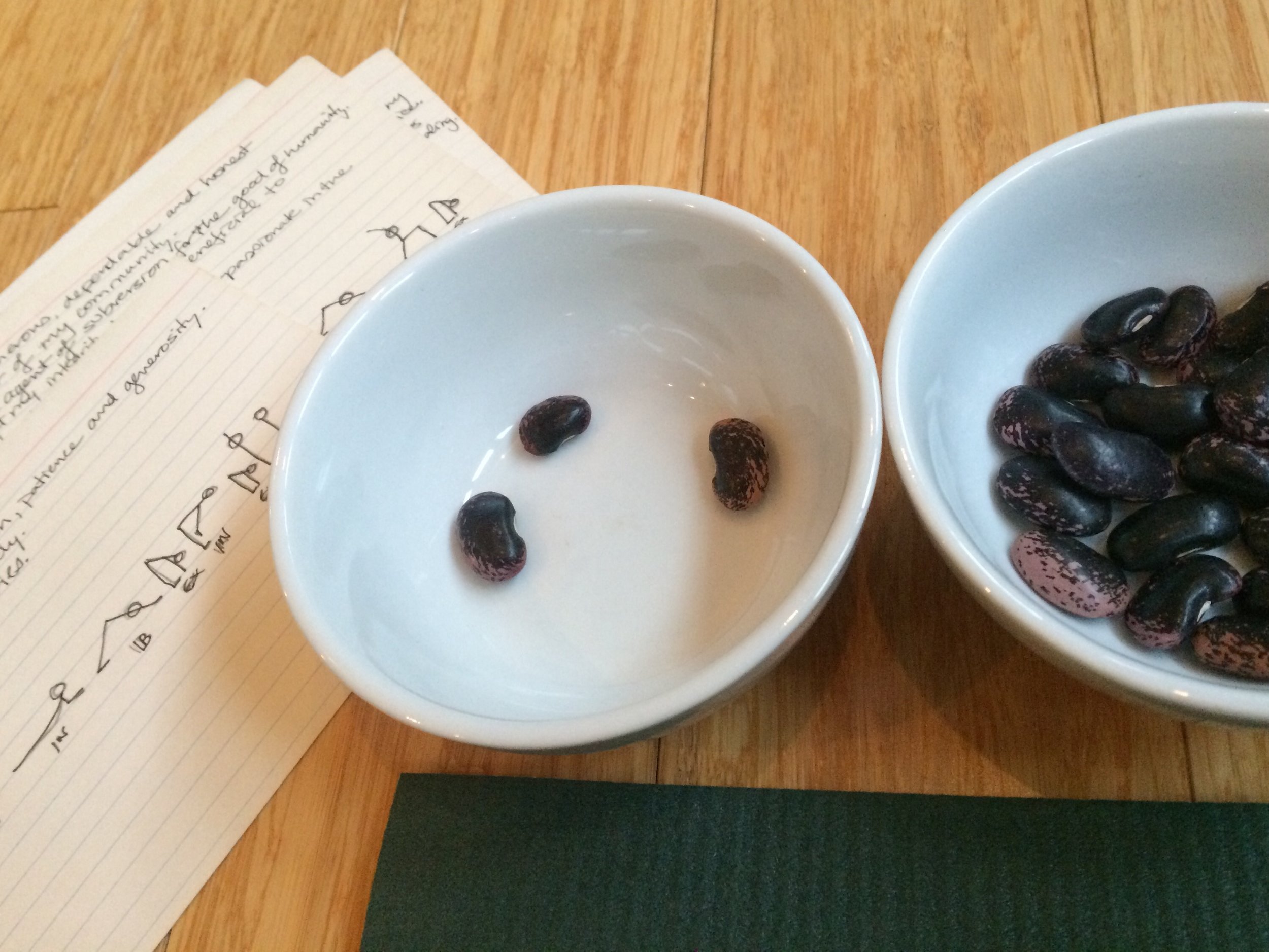
It was a pretty amazing experience. It wasn't the grueling, interminable, hard-working slugfest that 108 sun salutations can sound like: each of us did our own practice; we moved at our own pace, in a way that was sustainable, and energetically charged for each of us; we took rest when we needed it, and we wrapped when we were finished. Around the room, you could hear the sound of breath moving through bodies, and feet stepping forward and back, and the soft plink, plink, plink of scarlet runner beans being moved from one bowl to another. It was beautiful. Being able to share an experience that meant so much to me personally with other people was a real gift; I love creating community around acts of ritual. There were points at which I felt my own resolve flagging, and I would reach out energetically to others in the room who were steady and focused, and hitch a ride on their wave. There were also times when I felt others losing steam, and I would think, c'mon, sweetie, we're in this, we got this, and I'd focus my gaze and my movement and my energy. The give and take of practice in the room was powerful and rare. 

On a personal level, the ritual gave me the chance to set some intentions for the person I want to be, for how I want to treat myself, my loved ones, my community. I won't share all of the intentions I set, but a few I feel are pretty special include:

  • I am resilient.
  • I release behaviors and relationships not in alignment with my growth and healing.
  • I set healthy boundaries.
  • I am an agent of subversion for the good of humanity.
  • I trust the Divine timing of The Universe.
  • I am strong, courageous, and compassionate in the face of adversity.

It was a wonderful day. I'm grateful to everyone who came to practice with me, and I'm so proud of all of us, working together, cultivating discipline, focus, shared energy, gratitude, and devotion. I sincerely hope it won't be the last time we can share the experience. 

Tags community, ritual, yoga
1 Comment

Do you feel me?

September 12, 2016 Jessica Young
A few of my favorite images of the moon, according to the Tarot.  

A few of my favorite images of the moon, according to the Tarot.  

After taking a few of my favorite Restorative Yoga classes with a truly gifted and sensitive teacher a some time ago, I picked up a book he'd read from, and also borrowed his deeply moving habit of reading to students occasionally in the Restorative class that I teach. I was reading recently from Fire of Love, by Aadil Palkhivala, and shared this from his chapter on Feeling:

Feeling is the essence of life. Without feeling, we are not quite human. The real value of our asana practice is that, as we do pose after pose with awareness, we are inviting more sensitivity into our bodies and our lives. We are learning to tune in and feel. So we not only feel better, but we feel better. 

It makes a lot of sense to me, but I'd be lying if I said that there aren't times when I wish I didn't feel quite so much. Truth is, I'm a big, ol' feeler: whether it's joy, terror, anger, confusion sadness, or anything else or in between, when I feel a feeling it's almost always an 11 on a scale of one to ten. Anyone who knows me will tell you that I'm more than a little expressive about my feelings, too. I sometimes wish that I moved through the world with more equanimity: I think it would spare me a lot of lost energy and heartache; but I just don't. What I feel, I feel deeply.

For better or for worse, yoga--and by this, I mean not just asana, but the eight-limbed practice of yoga, the gritty, tearful moments of svadhyaya, the struggle to soften into ahimsa when I'm frightened and irritable, the fleeting moments of pratyahara that I pursue even as my monkey mind is crying out for more Netflix--this practice has taught me to feel more. Practicing yoga is what clued me into the fact that I feel lousy when I eat meat; it's what has given me the bravery to end toxic relationships; it's what has shown me how much it matters to me to offer what I study, what I practice, to others. 

But sometimes I really hate The Feels.

You can never un-know a thing, can you? Even if you choose to feign ignorance about how that chicken thigh made its way under the mushroom sauce on your plate, or what your uncle did to your little sister, or that you just aren't in love with them anymore, that feeling will find a way out. It'll manifest as a nagging pain in your neck, or as acid stomach, or nightmares. The truth will out. The truth doesn't really have a feeling. If your hamstrings are too short and your hips too tight today for you to put your feet behind your head, well, that isn't great and it isn't terrible; it just is. Likewise, if that person doesn't love you the way you want them to, that isn't inherently bad or good; it's just a fact of the nature of your relationship with them. If you try to do dwi pada sirsasana in light of the truth about your hips and hamstrings, I promise you, you will have a feeling. If you try to make someone love you when you know they can't, oh Honey, take it from me, you'll get a boatload of feelings as a result of that ill-advised action.

The feeling comes in our reactivity. This retrograde/eclipse season is really revealing to me some things that were hidden. The waxing and waning light of the moon has a way of doing that: at night, the shadows are long and exaggerated, and we're not sure what it is we see. Things can look scarier than they are; sometimes people we thought were there, aren't there at all (which could be good for us, or bad, depending on how we feel about who we thought was there in the first place). Sometimes relationships we counted on are revealed to be shallow, and we're faced with the choice of investing or cutting our losses. 

Feelings seldom feel like a choice, though. I don't know about you, but I often give my feelings such privilege that it's tough to remember that they're fleeting, that--like the shadows of the moonlight--they may not be an accurate reflection of the truth. I don't believe feelings are a choice. I've heard that before, I just don't buy it. But I am learning (often quite painfully, as the princess of The Feels) that feelings don't have to be in charge. My anger, my pain, my disappointment, my loneliness, my lust, my resentment, my yearning: none of these need to be in charge of the decisions I make. They have useful information to offer, but they may not be there when the sun comes up. So even though my feelings aren't a choice, how I hold my feelings, and how I act in dialogue with them is a choice.

Damn, it's beginning to sound a little Multiple Personality up in here. 

Feelings come up a lot in my physical practice. I've never been the yogini who laughed, or cried, in ekapadarajakapotasana, but I have been the yogi furious with the teacher for asking us to do another balancing pose, or furious with her flat feet for not supporting her in said balancing pose; I am currently the yogini walking a tightrope of encouraging myself to be brave in dialogue with postures where I've hurt myself before (bravery, excitement), and not being so caught up in my ego and in grasping for postures that I hurt myself. Again. (fear, discouragement, laziness?)

The practice never lies. Never. How we react to it, our ego, (source of The Feels) lies all the time. What I discover about yoga, in the subtle practices of pranayama, pratyahara and dharana, is that these practices lift up The Feels. There's no vinyasa to rinse them away like sorbet between sequences, there's no second side to try it again and see what happens this time; there's only me and my breath and the feeling, and the floor beneath me, and sometimes I forget that last part. And so I sit with the feeling, I hold it and interrogate it, and I don't try to make it go away. On a good day, this is a wordless experience, and then maybe some clarity lifts up within me, and usually that is language-based. On most days, my cognitive mind takes the reins and acts like some kind of ethnographer, and I have to keep telling myself to shut up. On a bad day, the feeling wins and there is no clarity, there is only the glaring feeling itself, and I have to work not to step off the mat in a totally triggered state, I have to remember to leave my practice behind.

Being a grown-up is not easy. When you're six months old and you have a feeling you don't know what to do with, you wail about it until someone puts something in your mouth, or cleans you off, or puts you to bed, and you feel better. Something similar happens when you're three or six. But when you're fourteen, twenty-two, thirty-six, fifty-seven, it isn't as simple anymore. The feeling itself may be as "uncomplicated" as fear, fatigue, hunger, loneliness, but man, how it manifests in our world of relentless cell phones and mortgages and climate change and Black Lives Matter and guarding borders is a giant snare, and how adults deal with their feelings has huge consequence on one another's lives. 

And so I unroll my mat and I practice. I move my body through space, and I try to examine my feelings without attaching too much to them, even when I'd rather just put something in my mouth and clean myself off and go to bed. I sit beside myself. I imagine myself sitting beside me, laying my head on my own shoulder in a gesture of compassion and generosity that I want to show someone else, that I want to receive from someone else. I say to myself, it's okay, Jess. You're here, you're safe, and I love you. Sometimes that makes it better, sometimes it feels like it will be hard forever. But I'm in it. I don't run away from the feeling because I know it won't last, and I know that beneath it there's a truth I need to know.

Tags yoga, cul, philosophy, relationship
Comment

Mindful Transitioning

September 5, 2016 Jessica Young
I'm almost sure I've used this picture once before, but it bears repeating, no? Silver Lake, Los Angeles, 2012.

I'm almost sure I've used this picture once before, but it bears repeating, no? Silver Lake, Los Angeles, 2012.

“The intensity of practice reveals yoga’s nearness. ”
— threads of yoga, matthew remski

I had just turned 27, and everything was changing. My roommate had moved out; she announced at the beginning of summer that she was leaving Chicago to attend grad school in Philadelphia. I never said this to her, but I felt abandoned by her. I had connected with her in a way I never had before with another woman; despite being vastly different, I felt we understood each other. I learned so much from her. She challenged me, she encouraged me, and we had so much fun together. When she unplugged herself from my life, with as much effort as unplugging the toaster, I was heartbroken. I moved out of our beautiful three-bedroom apartment in East Humboldt Park and away from the spiritual community I'd built, into the only place I could afford, a tiny studio apartment.

I was awash in language. It was my last year of grad school, and I was completing my master's thesis, a collection of short stories about people I knew, people I didn't know, relationships and ideas and connections that fascinated and troubled me. I knocked around my hovel of a studio apartment in Uptown, dark, dingy, utterly unromantic, from bed to desk to stove to sink and back again. I bounced out the door once a week to a classroom in the South Loop where I taught a roomful of undergrads about what fun it is to make story. I bounced around the country teaching children, teens and adults the transporting magic of reading. I occasionally had brunch or looked at art with the man I'd eventually marry. I tried to go to yoga class, because there was no place to practice in my studio. And I spent every waking moment with my journal or in front of my computer making stories. 

I love writing. Crafting language is the first, last and best way I know of understanding the world around me, of celebrating what is marvelous and understanding what is frightening and untangling what is painful. Constructing language, when crafted without too much self-aggrandizement, with sincerity and beauty and simplicity, can be a spiritual practice. Language is what I use to practice compassion and vulnerability, two qualities I come more and more to believe are intrinsic to the human condition, despite overwhelming evidence to the contrary. But at the time, when I was 27 and adrift, there was just too much language in my life. Lines from the story about the two kids who found the dead body, lines from the story about the housewife's meltdown, lines from the story about what I imagined my grandparents' marriage could be like: they were all over me all the time. They were in my thoughts, under my fingers, in my mouth, it was like living in alphabet soup.

“Draw near to God, and he will draw near to you.”
— The Bible

I didn't know I was seeking silence when I started going to yoga class in Edgewater; I just knew the studio was close to my boyfriend's place and the Sunday night community class was half-primary, which I had a crush on at the time. I found silence. I would go to class, and once we started moving, there was a lot less talk, fewer words. I remember at one point, sweating through parivrtta trikonasana and parivrtta parsvakonasana, and realizing all I could hear was my breath. I was grateful for the silence: no music, no drums or kirtans, just my breath and the sound of my limbs on the mat, and whatever quasi-verbal sounds came out of me in a particular shape.

I kept going, because I needed the silence. Moving away from my spiritual community, losing my best friend, these things had left a hole in me, and even though church in the traditional sense was still available to me, it just felt too language-based. I wanted to be close to the G_d that lived in the space between words, in spaces: not the God of edicts and rules, or rhetoric, or even worship.  Yoga felt like a spiritual practice, as much as attending church, reading holy books, even praying, ever had. I was moving into a new place where my physical practice felt like prayer. 

I've been reading threads of yoga lately. It's slow, dense, something you need to digest in small bites because it features words I don't understand clearly, like "ontological" and "praxis". This isn't a judgment of the text, only a statement of how slowly I must engage it to understand. But when I engage it slowly, it hits me fast and heavy, the way a rainstorm blows in, soaking everything, threatening a flash flood. The text helps me consider what yoga is: is it something I do to keep my blood pressure low, is it something I do because I like touching my toes; is it a Western subculture largely dominated by a energy of privilege and homogeneity, that for all of its talk about union and spirituality, is in staunch denial of its shadow side, and the ways in which that manifests oppression; is it more than exercise, or not more than cultural appropriation; is it prayer...

My practice feels as though it moves not linearly, but in concentric circles. Rather, it moves linearly when I consider only what can I do with my body. When I  consider that I can touch my toes standing and seated, when a bind in half-lotus feels not so tight and impossible, when I can move my body through the transitions my teachers ask me to with a tiny bit more grace than I could a few months ago, then my practice moves linearly. This is interesting, but only for a short while, if I set my sights on the next pose, the next vinyasa, the next physical feat.

But when I consider the practice that feels like home when I can't make words, when I step to the mat--tired, confused, frustrated, alienated--and it feels like a prayer rug, when I touch the tide of yearning that rises within me wanting to dive deeper into the practice that, beneath all the commerce and homogeneity and (I'll say it again) oppression, beneath all the acting out and the ego and the missteps of humans, is something healing, even holy: Ah! Then it feels like a spiral, a cycle I move through ever deeper toward Divinity.

I bring this up right now because I feel in the midst of another of those transitions, those moments when I have the opportunity to choose whether or not to move deeper. There's a lot in my life that's making it difficult, but the call to move nearer, to engage in the practice more deeply, is so strong. Yoga lifts up parts of me that I don't really want to look at, that I'd rather pretend aren't there, or that I've "overcome". It is a fine mirror, accurate, honest, surgically precise, in shining a light on the things I have sought to keep buried for so long. If my physical practice never changes, that is still a reason to step to the mat everyday: for the spiritual work the physical practice bids me do.

Tags yoga, religion, culture
2 Comments
← Newer Posts Older Posts →

Powered by Squarespace